Introduction: Where the Desert Meets the Sea
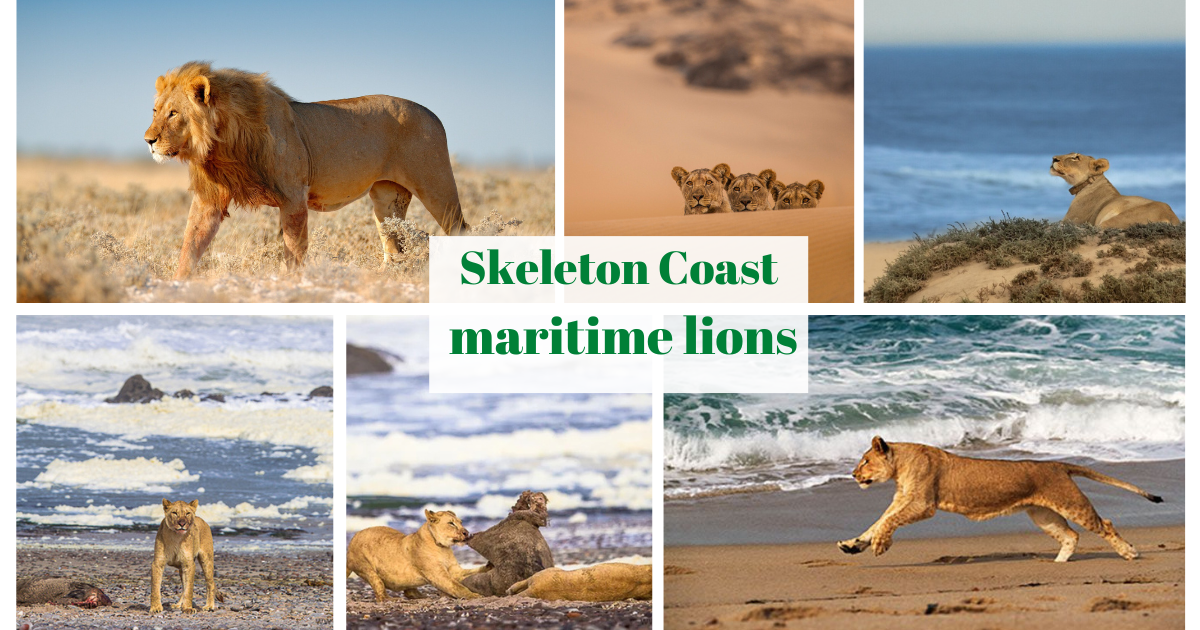
On Namibia’s remote northwestern edge lies a haunting landscape where the Atlantic Ocean crashes against endless dunes — the Skeleton Coast. Known for its shipwrecks, fog banks, and eerie silence, this wild stretch of coastline is also home to one of Africa’s most astonishing wildlife stories: the Skeleton Coast maritime lions.

These lions are unlike any others on Earth. Adapted to a desert where rain is scarce and food is elusive, they have learned to survive — and even thrive — by hunting along the coastline, feeding on Cape fur seals, seabirds, and scavenging whale carcasses.
The existence of lions in such a barren, salt-swept landscape challenges everything we know about Africa’s apex predators. This is their story — one of adaptation, resilience, and mystery in one of the most inhospitable places on the planet.
🦁 The Origins of the Desert Lions
Long before they became known as “maritime lions,” the big cats of northwest Namibia were simply part of the region’s desert-adapted lion population. These lions have roamed the Kunene region for centuries, surviving in the arid landscapes of the Namib Desert and the Skeleton Coast National Park.(Skeleton Coast: Mysterious shipwrecks and foggy shores)

However, by the mid-1990s, their numbers had plummeted due to human-wildlife conflict, poaching, and drought. For years, lions were rarely seen near the coast. But then, thanks to conservation efforts and natural dispersal, something remarkable happened — the lions began to reclaim their ancestral range, reaching all the way to the Atlantic shoreline.
Their return marked a new chapter in Namibia’s wildlife history: the rise of the maritime lion.
🌊 Life on the Edge: Adapting to the Skeleton Coast
The Skeleton Coast is one of Earth’s most extreme environments. Temperatures swing from scorching heat to freezing fog. Freshwater is almost non-existent. Prey is sparse. And yet, these lions endure.
🏜 How They Survive
- Water from Prey:
The maritime lions get most of their moisture from the animals they hunt — seals, oryx, and even seabirds. - Fog as a Lifeline:
The Atlantic’s cold Benguela Current creates dense coastal fogs that drift inland, cooling the desert and sustaining sparse vegetation. Lions use this fog for cover when hunting and to stay cool during the day. - Nocturnal Adaptation:
Hunting mostly at night or in the fog, they conserve energy and reduce heat stress while stalking their prey unseen.
These survival strategies are proof of extraordinary adaptation. No other lion population in Africa lives this close to the ocean — or hunts seals on the beach.
🦭 Hunting Seals: The Only Sea-Lions on Land
Perhaps the most fascinating behavior of the Skeleton Coast lions is their diet. While most African lions chase antelope or buffalo, these coastal predators hunt Cape fur seals along the rocky shores and sandy beaches.
The Hunt

At dusk or dawn, the lions move stealthily through the dunes toward seal colonies. With patience and precision, they launch sudden attacks, sometimes dragging seals inland to feed.
This behavior has been documented through camera traps and research by the Desert Lion Conservation Project, revealing that these lions are capable of marine predation — a world-first for the species.
It’s an adaptation born of necessity, but also a testament to evolution’s creativity. These are true maritime predators, straddling two ecosystems: the ocean and the desert.
📸 The Return of the Coastal Pride
For decades, maritime lions were thought to be extinct. Then, in 2017, researchers and local guides began to record sightings along the Hoanib and Uniab rivers, where lions had once roamed.
These lions, led by females like Xpl-108F (“Alpha”) and Xpl-111 (“Ome”), became symbols of resilience. Tracking data showed that they covered enormous distances — sometimes over 150 kilometers — in search of prey and water.
By 2020, several prides had reestablished territories between Mowe Bay and Torra Bay, proving that nature, when given space and protection, finds a way to recover.

🧭 Skeleton Coast National Park: A Land of Ghosts and Giants
Spanning over 16,000 square kilometers, Skeleton Coast National Park is one of the most dramatic wilderness areas in Africa. It’s a place of contradictions — hauntingly beautiful yet perilous.
What You’ll Find Here:
- Shipwrecks like the Eduard Bohlen and Dunedin Star, half-buried in the sand.
- Seal colonies numbering in the thousands.
- Oryx, brown hyenas, jackals, and even elephants wandering the dunes.
- And now, the return of the coastal lions — completing the circle of life along Namibia’s wild edge.
This park is a UNESCO World Heritage candidate and one of Africa’s least disturbed ecosystems — a place where you can still feel the raw, untamed pulse of nature.
🌅 Safaris and Expeditions: How to See the Maritime Lions
Seeing the Skeleton Coast maritime lions in the wild is a once-in-a-lifetime experience — but it’s not easy. Access is tightly controlled to protect the fragile ecosystem and its wildlife.
🏕 Where to Go
- Hoanib River & Hoanib Skeleton Coast Camp – Operated by Wilderness Safaris, this eco-lodge offers guided expeditions through lion territory.
- Mowe Bay to Terrace Bay – Remote coastal areas where lions and seals often overlap.
- Palmwag Concession – A vital buffer zone between inland desert lions and coastal prides.
🚙 How to Get There
Most visitors arrive via fly-in safaris from Windhoek or Swakopmund, landing on private airstrips. Self-drive options exist for experienced overlanders, but permits are essential.
🔍 Recommended Safari Partners
Explore maritime lion territory with trusted tour operators:
- GetYourGuide – Namibia Safaris
- Viator – Skeleton Coast Adventures
- Booking.com – Stays near Skeleton Coast
- DiscoverCars – Namibia 4×4 Rentals
Sossusvlei: Climb Some of the World’s Tallest Sand Dunes
🛡 Conservation: Protecting Namibia’s Desert Lions
The Desert Lion Conservation Project, led by Dr. Flip Stander, has been at the forefront of protecting these lions for over two decades. Through GPS tracking, behavioral studies, and community outreach, the project has helped balance the relationship between wildlife and rural communities.
Key Conservation Goals:
- Minimize human-lion conflict near settlements.
- Monitor lion movements and survival rates.
- Promote sustainable eco-tourism that benefits locals.
- Educate communities on the value of lions as a national heritage.
Thanks to these efforts, the population of desert lions — including the maritime prides — has slowly increased, bringing hope to conservationists worldwide.
🌾 Coexistence and Community
The presence of lions along the Skeleton Coast isn’t just an ecological triumph — it’s also a social one. Local Himba and Herero communities have learned to coexist with these apex predators through compensation programs and wildlife tourism benefits.
Many lodges now employ local guides who share traditional knowledge about desert survival, turning conservation into a livelihood.
By visiting responsibly, travelers directly support these efforts — helping ensure that the roar of the maritime lions continues to echo across Namibia’s dunes.
📚 Interesting Facts About Skeleton Coast Maritime Lions
- Seal Hunters: The only lions in the world known to regularly hunt marine mammals.
- Fog Navigators: They rely on the Atlantic fog for moisture and camouflage.
- Extreme Range: Some lions travel up to 200 km in search of food and mates.
- Female Pioneers: The first lions to reach the coast in modern times were females leading their prides.
- Camera-Trap Celebrities: Their lives have been featured in numerous documentaries, including Vanishing Kings: Lions of the Namib Desert.
🧳 Travel Tips for Visiting the Skeleton Coast
Best Time to Visit:
- May to October (Dry Season): Cooler temperatures and better visibility for wildlife.
Permits & Access:
- You’ll need a Skeleton Coast entry permit from the Ministry of Environment, Forestry and Tourism.
- Only a limited number of travelers are allowed north of Torra Bay without a guided tour.
What to Pack:
- Warm layers for foggy mornings and cold nights.
- High-SPF sunscreen and a wide-brimmed hat.
- Binoculars, camera with zoom lens, and extra batteries.
- Ample water and fuel if self-driving.
Respect the Wildlife:
Never attempt to track lions on your own. Always travel with licensed guides who understand the terrain and wildlife behavior.
🌄 The Magic of the Skeleton Coast
The Skeleton Coast is more than just a destination — it’s an emotion. It evokes awe, silence, and humility. Standing on the dunes, with the Atlantic’s cold wind in your face and lion tracks in the sand, you realize how powerful and fragile life can be.
The maritime lions of Namibia are symbols of survival and balance — reminders that even in the harshest environments, life finds a way.
As conservation efforts continue and sustainable tourism grows, these lions offer hope — not just for their species, but for our planet’s wildest frontiers.
🌍 Plan Your Skeleton Coast Adventure
Dreaming of witnessing Namibia’s wild beauty for yourself? Start your journey here:
- 🏨 Book Your Stay – Hotels & Lodges in Namibia
- 🚗 Rent a 4×4 Car – DiscoverCars Namibia
- 🦁 Join a Guided Safari – GetYourGuide Namibia Tours
- 🌍 Book an Excursion – Viator Skeleton Coast Adventures
🦁 Final Thoughts
The Skeleton Coast maritime lions represent one of the most remarkable wildlife stories of the 21st century — a living testament to adaptation, endurance, and the resilience of nature.
Their silent reign along the fog-drenched dunes of Namibia is not just a scientific curiosity but a profound symbol of hope for wild places everywhere.
If you ever find yourself wandering the edge of Africa where desert meets the sea — listen carefully. You just might hear the distant roar of the maritime lions of the Skeleton Coast.



3 thoughts on “Skeleton Coast Maritime Lions: Namibia’s Wildest Coastal Predators”